

AMR Technology: Transforming Warehouse Automation in 2026
Share on
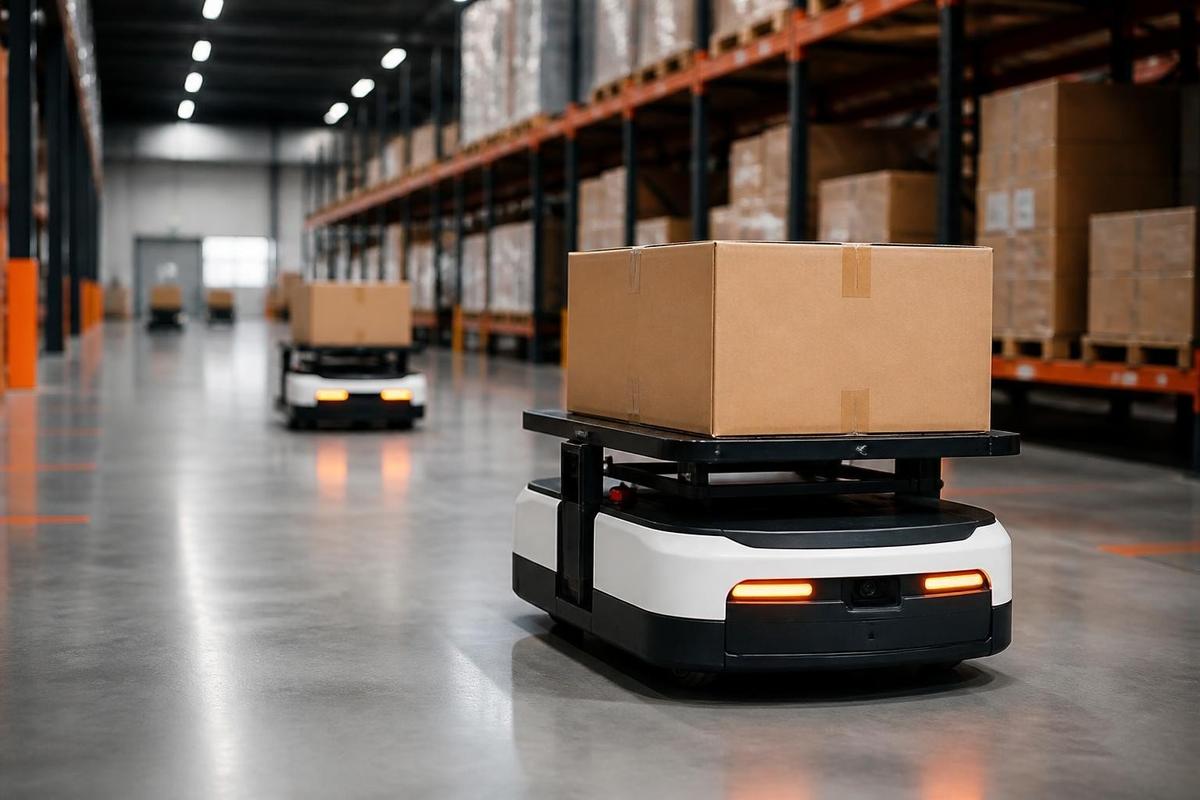
Autonomous mobile robots have emerged as a cornerstone technology in modern warehouse automation, fundamentally changing how logistics operations move goods, manage inventory, and fulfil orders. Unlike their predecessors, AMR systems combine advanced artificial intelligence, sophisticated sensor arrays, and dynamic navigation capabilities to create truly flexible material handling solutions. For warehouses across New Zealand and Australia facing increasing order volumes, labour shortages, and demands for faster fulfilment, understanding how autonomous mobile robots function and integrate into existing operations has become essential for maintaining competitive advantage.
Understanding Autonomous Mobile Robot Technology
An AMR represents a significant evolutionary leap beyond traditional automated guided vehicles. Where older systems relied on fixed tracks, magnetic strips, or reflective tape to navigate predetermined routes, autonomous mobile robots use onboard intelligence to perceive their environment, plan optimal paths, and adapt to changing conditions in real-time.
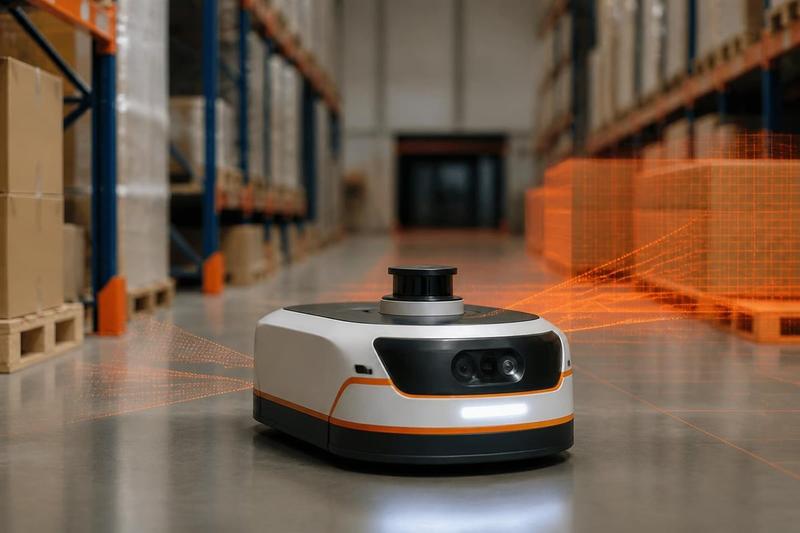
The core technological components that enable this autonomy include simultaneous localisation and mapping (SLAM) algorithms, LiDAR sensors, depth cameras, and sophisticated software that processes environmental data milliseconds after capture. These systems work together to create dynamic spatial awareness that allows the robot to identify obstacles, calculate alternative routes, and safely navigate alongside human workers.
Navigation and Perception Systems
Modern AMR platforms employ multiple sensor modalities to build comprehensive environmental models. LiDAR sensors emit laser pulses to measure distances and create detailed 3D maps of warehouse spaces, whilst depth cameras provide visual context that helps distinguish between permanent structures and temporary obstacles.
The integration of AI and sensing technologies enables autonomous mobile robots to process complex scenarios that would challenge rule-based systems. Machine learning models trained on thousands of warehouse environments help these robots recognise patterns, predict human movement, and make contextual decisions about navigation priorities.
Recent developments in vision-based awareness estimation have further enhanced safety by allowing AMR systems to detect whether nearby workers are aware of the robot's presence, adjusting behaviour accordingly to prevent accidents or workflow disruptions.
Key Differences Between AMR and Traditional AGV Systems
Understanding the distinction between autonomous mobile robots and automated guided vehicles helps warehouses select appropriate technology for their operational requirements. The fundamental differences extend beyond navigation methods to encompass flexibility, implementation complexity, and scalability potential.
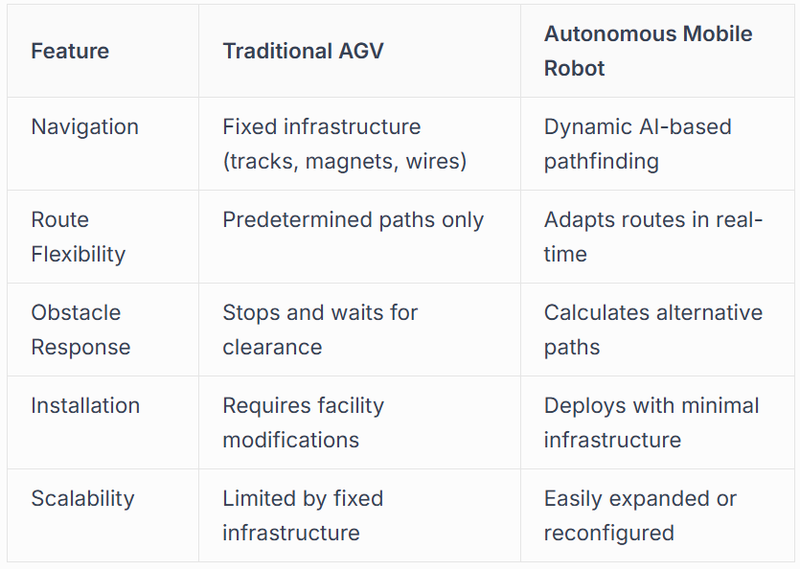
The infrastructure requirements represent perhaps the most significant practical difference. Automated guided vehicles necessitate substantial upfront investment in physical guidance systems, often requiring warehouse layout modifications that disrupt operations during installation. Autonomous mobile robots, conversely, can map existing facilities and begin operations with minimal physical changes.
Operational Flexibility and Adaptability
The ability to reconfigure workflows without infrastructure changes provides crucial operational advantages. When warehouse layouts evolve, seasonal products require different storage locations, or fulfilment strategies shift, AMR fleets adapt through software updates rather than physical reconfigurations.
This flexibility extends to handling fluctuating demand patterns. During peak periods, additional autonomous mobile robots can join the fleet seamlessly, whilst slower seasons allow units to be redeployed to different facilities or operational zones without infrastructure investment.
AMR Applications in Modern Warehouse Operations
Autonomous mobile robots serve diverse functions across warehouse environments, with applications spanning from basic transport tasks to sophisticated orchestration of complex workflows. The versatility of these systems enables logistics operations to address multiple operational challenges through strategic AMR deployment.
Goods-to-Person Picking Systems
Perhaps the most transformative application involves integrating autonomous mobile robots with goods-to-person automation strategies. In these configurations, AMR units retrieve entire shelving units or storage pods and transport them directly to ergonomic picking workstations, eliminating the need for workers to travel through aisles.
This approach delivers substantial productivity improvements. Pickers can process orders at rates three to five times higher than traditional cart-based picking methods, as robots handle all horizontal transport whilst workers focus exclusively on item selection and verification. For New Zealand and Australian warehouses implementing the Automate-X GTP Starter Grid, this represents an accessible entry point into warehouse automation that delivers immediate productivity gains.
The synergy between autonomous mobile robots and goods-to-person systems creates particularly compelling value propositions for e-commerce and 3PL operations processing high SKU counts with variable order profiles. Robots continuously optimise storage density by repositioning frequently accessed items closer to picking stations, whilst slower-moving inventory migrates to peripheral storage zones.
Inventory Transport and Replenishment
Beyond picking applications, AMR technology excels at horizontal transport tasks throughout warehouse facilities. Units autonomously move pallets, totes, and cartons between receiving docks, storage zones, packing stations, and shipping areas following dynamic routing algorithms that minimise congestion and travel time.
The robots integrate with warehouse management systems to receive task assignments, report completion status, and provide real-time location data for inventory tracking. This integration creates visibility into material flow that helps operations teams identify bottlenecks, balance workload distribution, and optimise overall throughput.
Fleet Management and System Control Architecture
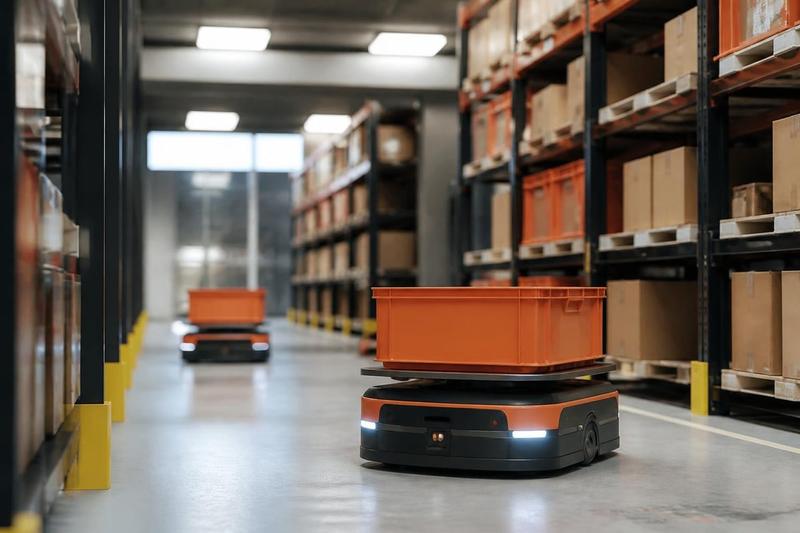
Deploying multiple autonomous mobile robots requires sophisticated orchestration to prevent conflicts, optimise task allocation, and maintain operational efficiency. Recent developments in AMR control systems have introduced increasingly intelligent approaches to fleet coordination that balance centralised oversight with distributed decision-making.
Centralised vs Decentralised Control Models
Traditional fleet management relies on centralised control systems that maintain complete awareness of all robot positions, task assignments, and facility conditions. Central controllers calculate optimal task allocation, assign missions to individual units, and resolve potential conflicts through comprehensive planning algorithms.
However, decentralised dynamic zoning algorithms represent an emerging alternative that distributes decision-making across the robot fleet itself. In these architectures, individual AMR units communicate with nearby robots to negotiate path sharing, coordinate task handoffs, and adapt to local conditions without constant central oversight.
The advantages of decentralised approaches include:
- Improved scalability as fleet size increases without overwhelming central processors
- Enhanced resilience through elimination of single points of failure
- Reduced communication overhead by limiting coordination to relevant nearby units
- Faster response times to local conditions through autonomous decision-making
Task Allocation and Priority Management
Effective fleet management requires intelligent task allocation that considers robot capabilities, current positions, battery status, and competing priorities. Sophisticated algorithms evaluate multiple factors to assign tasks efficiently:
- Proximity analysis calculates which robots can reach task locations fastest
- Capability matching ensures robots with appropriate attachments receive compatible tasks
- Battery management prevents low-charge units from accepting distant assignments
- Priority weighting directs resources toward time-sensitive or high-value tasks
- Workload balancing distributes assignments to prevent individual robot saturation
These systems continuously optimise as conditions change, reassigning tasks when higher priorities emerge or robot availability shifts. Integration with broader software automation platforms enables AMR task allocation to consider warehouse-wide objectives beyond individual robot efficiency.
Integration with Existing Warehouse Infrastructure
Successful autonomous mobile robot deployment requires thoughtful integration with existing warehouse systems, equipment, and workflows. Unlike greenfield facilities designed around AMR capabilities, established warehouses must accommodate robots within operational constraints that include legacy equipment, ongoing fulfilment demands, and workforce considerations.
Compatibility with Storage Systems
Autonomous mobile robots demonstrate particular versatility when integrated with various storage methodologies. In facilities utilising automated storage and retrieval systems, AMR units often handle horizontal transport between ASRS units and downstream processes, creating hybrid automation architectures that leverage the strengths of both technologies.
Standard rack-to-person AMR configurations illustrate how robots can engage with conventional pallet racking through specialised lifting mechanisms that raise entire rack sections for transport to picking stations. This approach enables goods-to-person benefits without requiring wholesale storage infrastructure replacement.
The robots equally support traditional shelving, flow racks, and dynamic storage systems, adapting through interchangeable end-effectors and software configuration rather than mechanical redesign. This modularity protects warehouse investment in existing infrastructure whilst enabling incremental automation expansion.
Workforce Integration and Safety Protocols
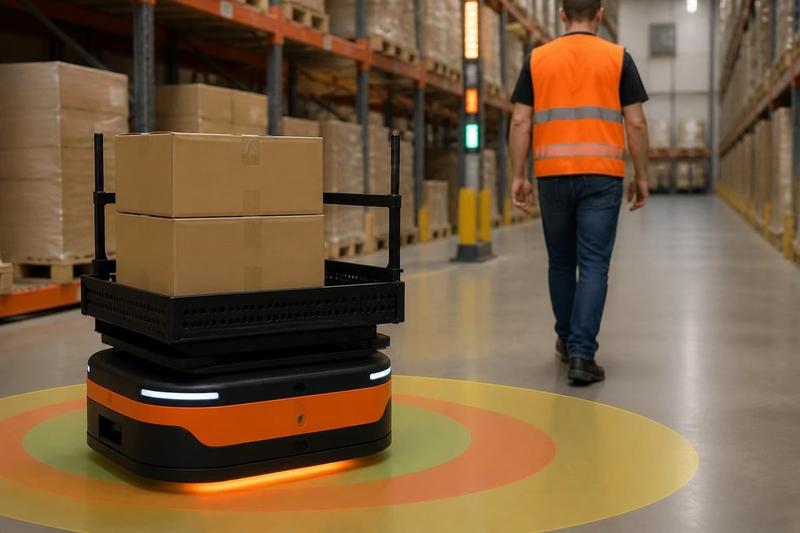
Introducing autonomous mobile robots into facilities with human workers requires careful attention to safety systems and operational protocols. Modern AMR platforms incorporate multiple safety features designed to protect personnel whilst maintaining productivity:
- Multi-sensor obstacle detection identifies humans, forklifts, and objects in robot paths
- Adjustable safety zones create larger clearances in congested areas or near intersections
- Audio-visual warning systems alert nearby workers to robot presence and intended movements
- Emergency stop capabilities allow manual intervention when necessary
- Reduced speed protocols activate automatically in high-traffic zones
Beyond technical safeguards, successful integration requires workforce training that familiarises staff with robot behaviour, establishes clear communication protocols, and builds confidence in the technology's safety systems. Operations that invest in comprehensive change management typically achieve faster adoption and higher productivity gains.
Performance Metrics and ROI Considerations
Evaluating autonomous mobile robot investments requires understanding the metrics that drive return on investment and operational improvements. Logistics operations should establish baseline measurements before deployment and track key performance indicators that reflect AMR contribution to warehouse objectives.
Productivity and Throughput Improvements
The most immediate benefits typically manifest through enhanced productivity metrics. Warehouses deploying AMR technology for picking applications commonly report:
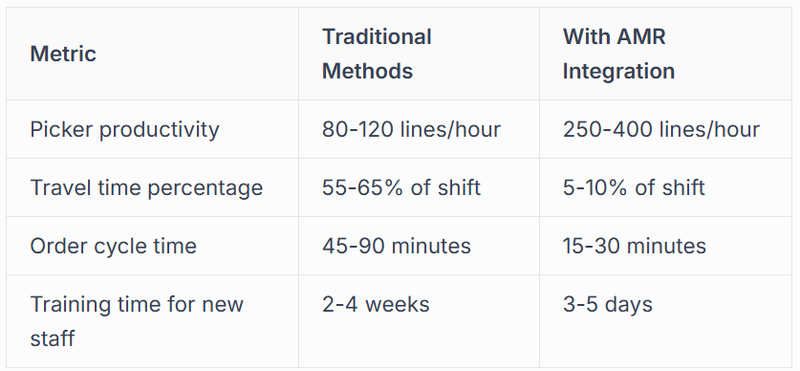
These improvements stem from eliminating non-value-added travel, reducing physical demands that cause fatigue, and simplifying workflows that previously required extensive facility knowledge. The compounding effect of multiple productivity enhancements often exceeds initial projections.
Accuracy and Quality Metrics
Beyond speed improvements, autonomous mobile robots contribute to quality outcomes through consistent execution and reduced error opportunities. Facilities tracking accuracy metrics frequently observe:
- Reduced picking errors through directed work sequences and verification prompts
- Improved inventory accuracy via systematic cycle counting integrated with AMR movements
- Decreased damage rates from consistent handling protocols and optimised travel paths
- Enhanced order completeness through systematic fulfilment sequences
These quality improvements reduce costly downstream corrections, customer service interventions, and reputation impacts that result from fulfilment errors. For operations serving pharmaceutical, food and beverage, or other regulated industries, accuracy improvements carry particular significance.
Implementation Strategies and Deployment Models
Approaching autonomous mobile robot implementation through structured deployment strategies helps warehouses manage risk, validate benefits, and scale successful applications. The transformation of logistics through automation requires careful planning that balances ambition with practical constraints.
Phased Deployment Approaches
Rather than wholesale facility transformation, many successful AMR implementations begin with targeted pilot deployments that address specific operational pain points. This approach offers several advantages:
- Limited initial investment reduces financial risk whilst demonstrating capabilities
- Focused learning allows teams to develop expertise in controlled environments
- Validated benefits provide concrete data supporting broader investment decisions
- Incremental scaling spreads capital expenditure whilst building operational confidence
- Minimised disruption maintains service levels throughout implementation phases
Typical pilot projects focus on high-volume, repetitive tasks where AMR advantages are most evident. Fast-moving product lines, returns processing, or specific customer fulfilment programmes represent common starting points that deliver measurable improvements within constrained scopes.
System Integration Requirements
Successful AMR deployment requires integration across multiple technology layers. Industrial system integration capabilities become critical when connecting autonomous mobile robots with warehouse management systems, enterprise resource planning platforms, and operational control systems.
Integration points typically include:
- WMS connectivity for task assignment, inventory updates, and completion confirmation
- ERP synchronisation for order data, inventory allocation, and performance reporting
- Material handling equipment interfaces for conveyor systems, sortation equipment, and automated doors
- Building management systems for coordinated operation with HVAC, lighting, and access control
- Analytics platforms for performance monitoring, predictive maintenance, and continuous improvement
The complexity of these integrations reinforces the value of working with experienced automation partners who understand both robotics capabilities and broader warehouse technology ecosystems. Proper integration transforms isolated AMR deployments into components of cohesive automation strategies.
Future Developments in AMR Technology
The autonomous mobile robot landscape continues evolving rapidly as advances in artificial intelligence, sensor technology, and robotics hardware expand capabilities and enable new applications. Understanding emerging trends helps warehouse operations anticipate future possibilities and make technology investments that remain relevant as the field progresses.
Enhanced Manipulation Capabilities
Current AMR platforms excel at transport tasks but typically require human intervention for item manipulation. Real-world applications increasingly demonstrate robots with integrated manipulation capabilities that combine mobility with picking, placing, and handling functions.
These enhanced systems employ robotic arms, gripper technologies, and vision systems that enable autonomous item handling without human assistance. For operations seeking to extend automation beyond transport into order assembly, these developments represent significant opportunities.
Collaborative Intelligence and Adaptive Learning
Future AMR systems will likely demonstrate increased autonomy through machine learning capabilities that enable robots to improve performance based on operational experience. Rather than relying solely on pre-programmed behaviours, these systems will recognise patterns in warehouse activities, anticipate common scenarios, and optimise responses through continuous learning.
The integration of collaborative intelligence allows robot fleets to share learned experiences, accelerating capability development across entire deployments. A discovery made by one unit about efficient navigation through a particular facility area propagates to all fleet members, creating collective intelligence that exceeds individual robot capabilities.
Additionally, enhanced human-robot collaboration interfaces will enable more intuitive interaction between warehouse staff and autonomous mobile robots. Natural language processing, gesture recognition, and augmented reality displays represent emerging technologies that will simplify robot supervision and intervention requirements.
Autonomous mobile robots have matured into proven warehouse automation technologies that deliver measurable improvements in productivity, accuracy, and operational flexibility across diverse logistics environments. By understanding AMR capabilities, integration requirements, and deployment strategies, warehouses can harness these systems to address current operational challenges whilst building foundations for future automation expansion. Automate-X combines robotics expertise, warehouse software knowledge, and system integration capabilities to help logistics operations successfully implement autonomous mobile robot solutions tailored to their specific operational requirements and growth objectives.